Tag: MTG proxies

  • ProxyKing vs Budget MTG Proxy Sites: Which Should You Use?

    ProxyKing vs Budget MTG Proxy Sites: Which Should You Use?

    TLDR

    ProxyKing vs Budget MTG Proxy Sites comes down to what you need from your proxies.

    ProxyKing is usually the better fit when you want polished, sleeve-ready MTG proxy cards for Commander, cubes, and casual playtesting. Budget MTG proxy sites can make sense when you want to print a large stack of cards cheaply, especially for rough deck testing. The tradeoff is usually quality, consistency, support, finish, card selection, and how much you care about the cards feeling good in an actual deck.

    For most players, the smart answer is simple: use nicer proxies for cards you plan to play often, and use budget options for quick testing piles.

    ProxyKing vs Budget MTG Proxy Sites

    Cheap proxies are tempting. I get it. Nobody wants to spend hundreds of dollars just to find out a Commander deck feels clunky, or that a cube package is less fun than it looked on paper.

    That is the whole reason the ProxyKing vs Budget MTG Proxy Sites comparison matters. Both options can help you play more Magic for less money, but they are not trying to solve the exact same problem. ProxyKing is aimed at players who want better-looking, more reliable proxy cards for casual play. Budget MTG proxy sites are usually aimed at players who want the lowest possible cost per card.

    Neither approach is automatically wrong. The better choice depends on how you plan to use the cards.

    If you need a few expensive staples for a Commander deck, cube, or kitchen table setup, quality matters more. If you are printing 100 cards to test three different decklists this weekend, price may matter more. That is the real comparison.

    What Counts as a Budget MTG Proxy Site?

    A budget MTG proxy site is usually a lower-cost proxy printing option that prioritizes volume and price over premium finish.

    These sites often appeal to players who want to print:

    • Full Commander decks
    • Large playtest batches
    • Cube updates
    • Multiple deck versions
    • Placeholder cards before buying real singles
    • Casual decks for friends or newer players

    Budget sites can be useful. They make experimentation easier. They also lower the pressure around deckbuilding. You can try more ideas, fail faster, and avoid buying expensive cards before you know they belong in the deck.

    The downside is that budget proxies often feel like budget proxies. That can mean softer print quality, thinner or different card stock, less consistent cuts, odd color balance, lower-resolution scans, or cards that look fine across the table but not as good up close.

    For rough testing, that may be fine. For a deck you play every week, it may start to bother you.

    Where ProxyKing Fits Best

    ProxyKing is best for players who want MTG proxy cards that look clean, feel good in sleeves, and hold up well enough for repeated casual use.

    That makes the most sense for cards you actually care about playing.

    Think of cards like:

    • Dual lands
    • Fetch lands
    • Fast mana
    • Reserved List staples
    • Expensive Commander cards
    • Cube staples
    • Hard-to-find older cards
    • Showcase or alternate-art versions you want to enjoy at the table

    This is where ProxyKing has a cleaner value pitch. You are not just buying the cheapest stand-in possible. You are buying something that makes your deck easier to play and nicer to handle.

    That matters more than people admit. A Commander deck is not just a spreadsheet of card names. It is a physical object you shuffle, sleeve, sort, and hand to other people. If a proxy looks washed out or feels strange in the deck, you notice.

    Maybe not once. But after ten games? Probably.

    Quality Is the Main Difference

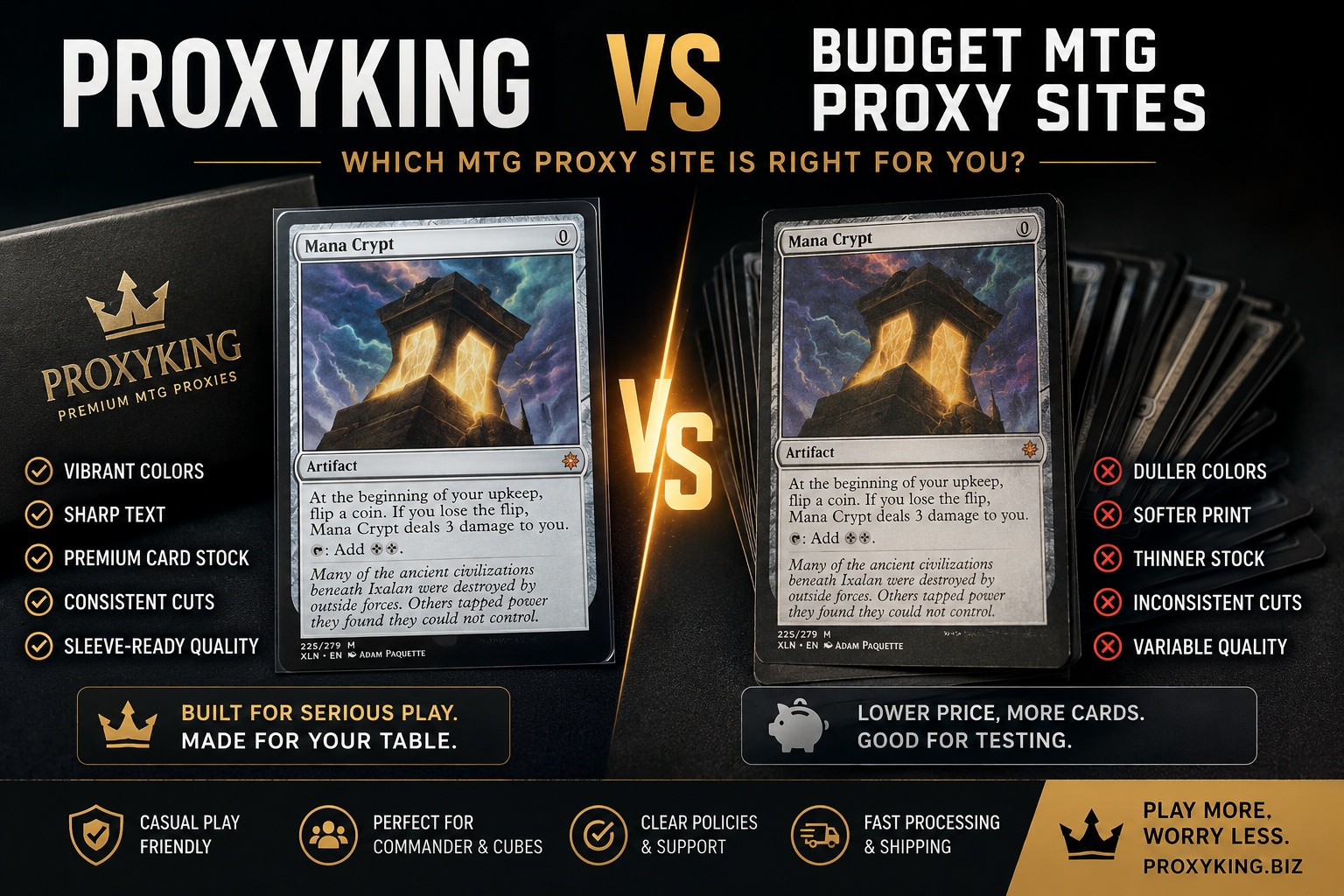
    The biggest difference between ProxyKing and budget MTG proxy sites is quality consistency.

    With proxies, “quality” is not one thing. It is a stack of small things:

    • How sharp the text looks
    • Whether the colors feel close enough
    • Whether the card is cut cleanly
    • Whether the corners look right
    • Whether the card sits well in a sleeve
    • Whether the finish feels decent
    • Whether the card is readable during real gameplay
    • Whether the whole order feels consistent

    Budget sites may get some of these right and miss others. A card might look good in a photo but feel flimsy in person. Or the front might look fine while the back, edge, or finish makes it obvious that it came from a cheaper print process.

    ProxyKing is a better fit when you want the card to feel like it belongs in the deck. Not as a counterfeit. That is not the point. But as a clear, playable, presentable stand-in.

    For most casual players, that is the sweet spot.

    Price Still Matters

    Budget MTG proxy sites win on one obvious point: cost per card.

    If you are trying to print an entire Commander deck, a large cube update, or multiple test decks, a premium per-card proxy option can get expensive fast. That is where a budget proxy site or print-on-demand service may be the practical choice.

    This is especially true when the cards are temporary. If you only need them for one night of testing, it is hard to justify paying more for nicer finish and better presentation.

    A good rule:

    Use budget proxies when the card is temporary.

    Use better proxies when the card is staying in the deck.

    That keeps spending under control without forcing every card into the same bucket. Your deck does not need premium proxies for every brainstorm card you may cut tomorrow. But your Gaea’s Cradle, Underground Sea, The One Ring, or Mana Crypt proxy is probably going to see enough play that a better version makes sense.

    Card Selection and Ordering Experience

    Budget proxy sites often shine when they let you paste in a full decklist and print everything at once. That is convenient. It is also one of the main reasons people use them.

    ProxyKing works better when you are shopping for specific cards, sets, staples, or high-value stand-ins. That can be a strength or a limitation, depending on what you are doing.

    If you want to grab a few expensive cards for a deck, that focused ordering experience is easy. Search the card, add it, move on.

    If you want to print 100 cards from a random Moxfield list, a bulk deck import system may be faster.

    So this part is not really about “better.” It is about workflow.

    ProxyKing is better for targeted upgrades.

    Budget sites are better for bulk experiments.

    The Sleeve Test Matters

    Most MTG proxies live in sleeves. That means a proxy does not need to perfectly match a real Magic card in every possible way. It needs to be readable, durable enough for casual play, and consistent enough that it does not create marked-card problems in your group.

    The sleeve test is simple:

    Put the proxy in the same sleeve as the rest of your deck. Shuffle it. Draw it. Play it. Ask if anything feels distracting.

    A good proxy should not pull your attention away from the game. You should be able to recognize the card, read the text, and keep playing.

    Budget proxies can pass this test for casual use. Some do. But the risk is less consistency. One batch may feel fine, while another has color issues, cut issues, or cards that do not sit the same way.

    ProxyKing is the better pick when you care about that in-sleeve experience.

    Support and Problem Resolution

    This is one of the less exciting parts of buying proxies, but it matters.

    Budget sites can be cheaper, but support quality varies. If cards arrive miscut, missing, blurry, or damaged, you want to know someone will actually help.

    A clearer support process can be worth paying for, especially when ordering cards you plan to keep using. Reprints, replacements, order tracking, and clear policies matter more when the order is not just a disposable test stack.

    Before buying from any MTG proxy site, check:

    • Does the site explain shipping?
    • Does it explain what happens if cards arrive damaged?
    • Does it have a contact page?
    • Does it clearly state what the cards are for?
    • Does it separate proxy use from counterfeit use?
    • Does it have realistic policies, not vague promises?

    This is one of those boring details that becomes important only after something goes wrong. Better to check before the order.

    Proxy Use: Keep It Casual and Clear

    MTG proxies are for casual play, playtesting, cubes, Commander pods, and unsanctioned groups that allow them.

    They are not for pretending a card is real. They are not for selling as authentic cards. And they are not for sanctioned tournament play unless an official judge issues a proxy under tournament rules.

    That distinction matters.

    A healthy proxy culture depends on transparency. If you sit down with a new group, say something before the game starts.

    A simple script works:

    “Quick heads-up: I’m running a few proxies for expensive cards. They’re readable and sleeved. Is everyone good with that?”

    Most casual Commander players will appreciate the honesty, even if their group has limits. Some groups allow anything. Some allow proxies only for cards you own. Some allow a set number. Some do not like them at all.

    You do not need to win a debate before every game. You just need the table to agree.

    When ProxyKing Is the Better Choice

    ProxyKing is the better choice when quality matters more than getting the absolute lowest price.

    Use ProxyKing when:

    • You only need a few cards
    • You want proxies for expensive staples
    • You are upgrading a Commander deck
    • You want a clean cube experience
    • You care about how the card looks in sleeves
    • You want a more polished casual-play proxy
    • You want clearer policies and support
    • You plan to use the cards repeatedly

    This is the “buy once, play often” option.

    It is especially useful for cards that would otherwise be financially unrealistic. A casual deck does not need to be locked behind the price of old cardboard. Proxies let people play the version of Magic their group actually wants to play.

    When Budget MTG Proxy Sites Make More Sense

    Budget MTG proxy sites make more sense when volume matters most.

    Use a budget option when:

    • You are testing a whole deck
    • You need a large cube batch
    • You are trying many card swaps
    • You do not care much about finish
    • You need the lowest cost per card
    • The cards may only be used once or twice
    • You are building teaching decks or loaner decks
    • You are still deciding what belongs in the final list

    There is no shame in this. Budget proxies are useful tools.

    The mistake is expecting the cheapest option to also deliver the most polished result. Sometimes it will be good enough. Sometimes it will not. That is the tradeoff.

    A Practical Buying Framework

    Here is the easiest way to decide.

    If the card is a long-term part of your deck, buy the nicer proxy.

    If the card is just for testing, use the budget proxy.

    If the card is expensive and highly visible, quality matters.

    If the card is bulk filler for a temporary list, price matters.

    If you are ordering for a cube, split the difference. Use better proxies for the iconic cards people will notice, and use budget proxies for experimental swaps.

    That approach keeps your costs reasonable while still making the cards you care about feel good at the table.

    Final Verdict: ProxyKing vs Budget MTG Proxy Sites

    ProxyKing vs Budget MTG Proxy Sites is not a hard either-or question.

    ProxyKing is the better choice for players who want cleaner, more polished MTG proxy cards for cards they will actually keep playing. Budget proxy sites are better for high-volume testing, quick deck experiments, and situations where the lowest price matters more than finish.

    I would not use the same proxy source for every situation.

    For a few expensive Commander or cube staples, go with ProxyKing.

    For a full rough-draft decklist you may tear apart next week, use a budget option.

    That is the most realistic answer. Spend where quality improves the play experience. Save where the card is only temporary.
  • PrintMTG Review: Ordering MTG Proxy Cards From PrintMTG.com

    PrintMTG Review: Ordering MTG Proxy Cards From PrintMTG.com

    TLDR

    • PrintMTG.com is best for players who want a simple way to print MTG proxy cards from a decklist, custom card design or precon-style list.
    • The ordering flow is one of the stronger parts of the site. You can paste a list, choose versions and review pricing before checkout.
    • As of June 2026, PrintMTG lists no minimum order quantity, quantity-based price breaks and free shipping on orders over $75.
    • The best fit is Commander decks, Cube, playtesting and casual table use where clean, readable cards matter more than collecting original printings.
    • My main caution is to review your decklist carefully before ordering, especially card versions, quantities, custom art and shipping details.

    A good proxy order should not feel like a side quest. You should be able to paste a decklist, pick the card versions you want, see the price clearly and get cards that feel normal once sleeved. That is the lens I used for this PrintMTG review.

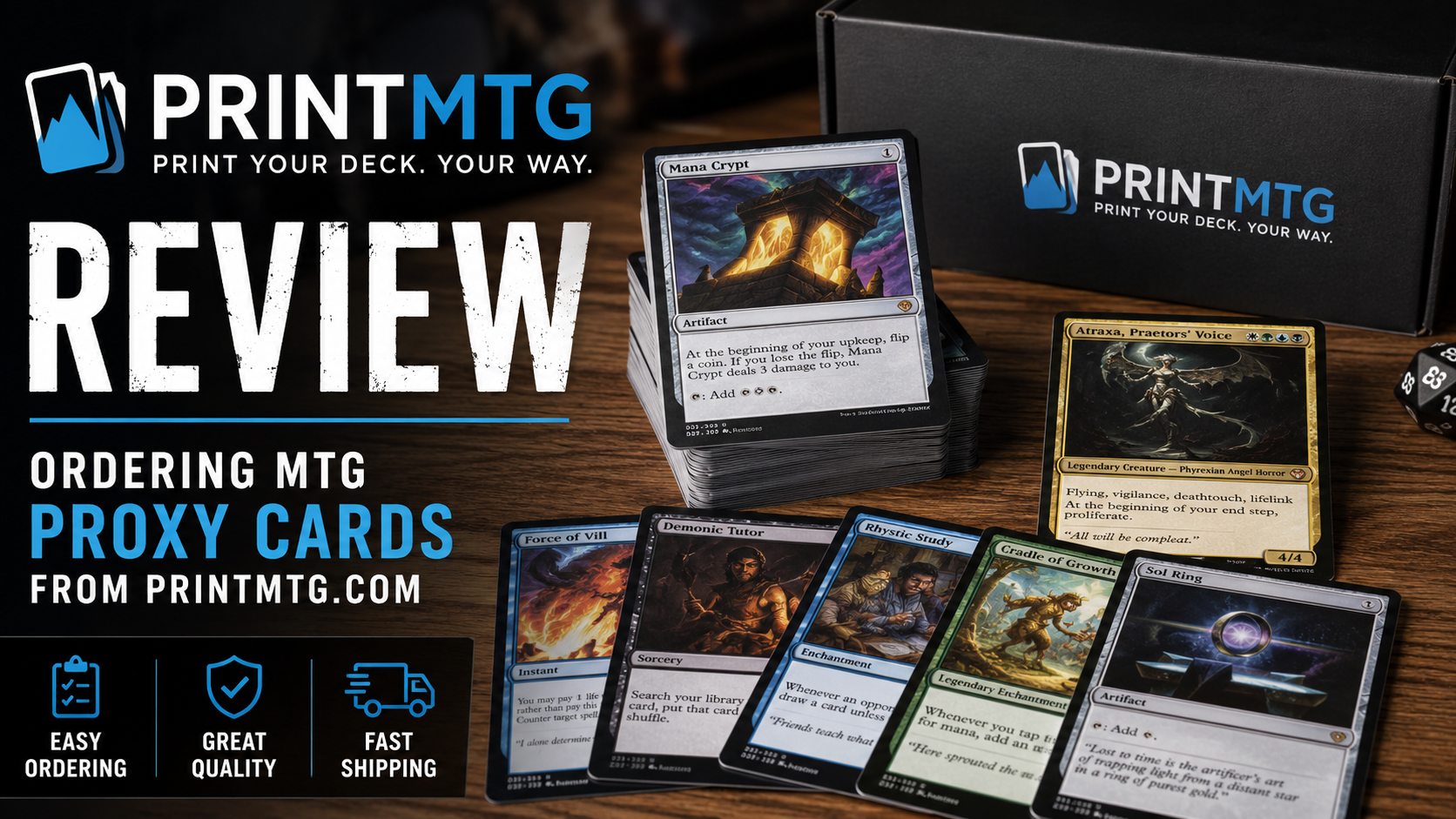
    PrintMTG.com is built around print-on-demand MTG proxy cards. The site lets you upload or paste a decklist, search for cards, browse sets, start from Commander precon lists or use an MTG Card Maker for custom designs. That gives it a pretty clear job: take a deck idea and turn it into a physical stack of proxy cards without making you manually build a print sheet.

    My short verdict: PrintMTG is a strong option if you want a clean, fast ordering experience for MTG proxies. It is especially useful for Commander players, Cube owners and anyone who likes testing decks before committing money to real singles. It is not the cheapest possible DIY method, and it is still worth checking your order closely, but the overall process is straightforward.

    What PrintMTG Is Best At

    PrintMTG is best at reducing friction. That matters more than people think.

    A lot of proxy workflows sound easy until you actually try them. You find card images, resize them, lay them out, print them, cut them, sleeve them and then realize half the cards look slightly off. DIY proxies can be fine for quick testing, but they are not always fun to handle. They also take time.

    PrintMTG’s main appeal is that it turns proxy printing into a regular online order. You can start with a decklist, choose the versions you want and let the service handle the printing and shipping. For MTG players, that is useful because decklists are already how most of us think. You are not designing a product from scratch. You are building a stack of cards.

    The site is also useful for players who care about specific printings. Maybe you want an old-border Lotus Petal look, a Secret Lair-style version or a specific Commander card treatment. PrintMTG lets you choose card versions instead of treating every card name as one generic image. That is a big quality-of-life feature for players who care about how the deck looks on the table.

    The other good fit is custom MTG cards. PrintMTG has a card maker that lets you edit card details, upload artwork and preview a design before ordering. I would treat that as a bonus feature rather than the main reason to order, but it is a nice option for custom tokens, house-rule cards, cube cards, joke cards or themed Commander projects.

    PrintMTG Review: The Ordering Process

    The ordering process is the best part of PrintMTG.

    The basic flow is simple:

    1. Start an order.
    2. Upload or paste your decklist.
    3. Pick the card versions and quantities.
    4. Review the order.
    5. Check out and wait for printing and shipping.

    That sounds obvious, but obvious is good here. Proxy sites can get clunky fast. PrintMTG keeps the main task close to the surface. You do not need to hunt through a maze of product categories just to begin.

    For a Commander deck, the decklist upload is the main feature I would use. Paste the list, review the matches and make sure each card is correct. This is where I would slow down. If a card has multiple versions, alternate frames or special treatments, double-check the exact printing before you order. A fast checkout is helpful, but a wrong card version is still a wrong card version.

    The precon tool is also interesting. PrintMTG lets you start from Commander precon deck lists, then adjust the list from there. That is useful if you want to test an upgraded precon before buying singles, or if you want a clean proxy version of a deck that gets passed around at game night.

    The custom card maker is more involved. That is expected. Uploading a decklist is mostly data entry. Designing a custom card means checking art placement, rules text, mana symbols, frames and spacing. The live preview helps, but you should still proofread custom cards carefully. Typos on a proxy are annoying. Typos on a full custom card are even more annoying because you know you had one job.

    Pricing, Card Stock and Shipping Expectations

    As of June 2026, PrintMTG lists quantity-based pricing on its homepage. The published price tiers start at $2.00 per card for very small orders and drop as the order quantity increases. At larger volumes, the listed per-card price gets much lower. That means PrintMTG makes the most sense when you are ordering a full Commander deck, a batch of upgrades, a Cube package or multiple decks at once.

    The site also lists no minimum order quantity. That is helpful if you only need a few playtest cards or replacement proxies for a deck. But from a value standpoint, small orders are not where PrintMTG looks strongest. The price breaks matter. A one-card order is convenient. A 100-card order is usually the better use case.

    PrintMTG describes its cards as printed on S33 German black-core playing-card stock with a smooth finish and standard TCG sizing. In plain English, the goal is for the cards to feel good in sleeves and shuffle like a normal deck. That is what matters for most proxy use. You want the cards to be readable, consistent and not distracting during play.

    Shipping is also fairly clearly explained. PrintMTG states that most orders are produced in about two business days, with standard U.S. orders typically arriving in roughly five to nine business days total when production and transit are combined. Expedited shipping options may be available at checkout. If you need cards for a specific event, I would not cut it close. Order early or contact support before placing the order.

    One useful policy detail: PrintMTG says if it makes a mistake with printing, finishing, cutting, packaging or shipping, it will reprint the order at its cost. That is the kind of policy I like to see on custom print products because custom orders are not usually “changed my mind” return-friendly.

    Card Quality: What Looks Good And What To Watch

    Based on PrintMTG’s own product details and the third-party review I found from Draftsim, the finished cards appear to land in the “good table proxy” category. The goal is not to create collectible originals. The goal is to create clean, readable proxy cards that look good in sleeves and feel consistent while playing.

    Draftsim’s hands-on review was generally positive. The reviewer said ordering was easy, the card art met expectations, delivery was timely and the card backs had a subtle difference. That last point matters. Proxy cards should be identifiable as proxies and not positioned as real Magic cards.

    The main critique in that review was packaging-related. The reviewer noted minor corner bending and light wear, likely from the cards being packed tightly in a toploader. The issue did not sound severe, but it is worth mentioning because card players notice corners. We always notice corners. We pretend we are above it, then immediately inspect corners.

    I would read that as a practical caution, not a deal-breaker. If you want near-mint collectibles, proxy printing is not really the category you are shopping in. If you want clean, sleeve-ready cards for Commander, Cube or playtesting, PrintMTG seems like a good fit.

    The public review picture is positive but still limited. Trustpilot shows a small number of reviews for printmtg.com, so I would not treat that score as a huge data set. It is a helpful signal, not a final answer by itself. The stronger evidence is the site’s clear ordering flow, published policies, public pricing and hands-on review coverage.

    Who Should Order From PrintMTG?

    PrintMTG makes the most sense for players who want convenience.

    Order from PrintMTG if you want to:

    • Print a full Commander proxy deck.
    • Test expensive cards before buying real copies.
    • Build a Cube without spending months tracking down cards.
    • Make casual playtest cards that look cleaner than paper slips.
    • Create custom MTG-style cards, tokens or themed cards.
    • Order in enough quantity to benefit from price breaks.

    I would be more cautious if you only need one or two cards and do not care how they look. In that case, a home printer and a basic paper proxy might be enough. It will not feel as nice, but it is cheap and fast.

    I would also be cautious if your order depends on very specific custom art placement, exact card versions or unusual card types. That does not mean you should avoid PrintMTG. It means you should spend more time reviewing the order before checkout.

    The best PrintMTG order is probably something like this: a 100-card Commander deck, a 50-card batch of Cube updates or a stack of playtest cards for a new brew. That is where the ordering flow, print quality and quantity discounts all line up.

    My Verdict On Ordering From PrintMTG.com

    I would recommend PrintMTG.com for players who want an easy, polished way to order MTG proxy cards without building everything manually.

    The site’s biggest strength is the ordering experience. Paste a list, pick versions, review pricing and check out. That is exactly how proxy ordering should work. The pricing is clearer than many custom-print workflows, and the published production and shipping expectations are specific enough to help buyers plan.

    The tradeoff is that you are paying for convenience. This will not beat the cost of printing paper proxies at home. But it should beat the hassle, and for many players that is the point.

    My practical advice: use PrintMTG for deck-sized orders, not tiny one-off tests. Check every card version before checkout. Upload high-quality art for custom cards. Order early if you need the cards by a specific date. And sleeve the cards before play, because proxy cards are still printed game pieces and game night is not gentle.

    FAQs

    Is PrintMTG Good For Commander Decks?

    Yes. Commander decks are one of the best use cases for PrintMTG because the decklist upload flow fits a 100-card format well. You can paste the list, choose versions and order the full stack together.

    Can I Order Just A Few MTG Proxy Cards?

    Yes. PrintMTG lists no minimum order quantity. That said, the pricing improves as order quantity increases, so larger orders are usually a better value.

    Does PrintMTG Let You Make Custom MTG Cards?

    Yes. PrintMTG has an MTG Card Maker that lets you upload artwork, edit card text, choose frames and preview the card before ordering prints. It is a good fit for custom tokens, playtest cards and personal projects.

    How Long Does A PrintMTG Order Take?

    PrintMTG states that most orders are produced in about two business days. Standard U.S. delivery is listed as roughly five to nine business days total, including production and transit. Expedited shipping may be available at checkout.

    What Should I Check Before Ordering From PrintMTG?

    Check card names, quantities, card versions, custom artwork, shipping address and the final price. If you are making custom cards, proofread every line of text before checkout.