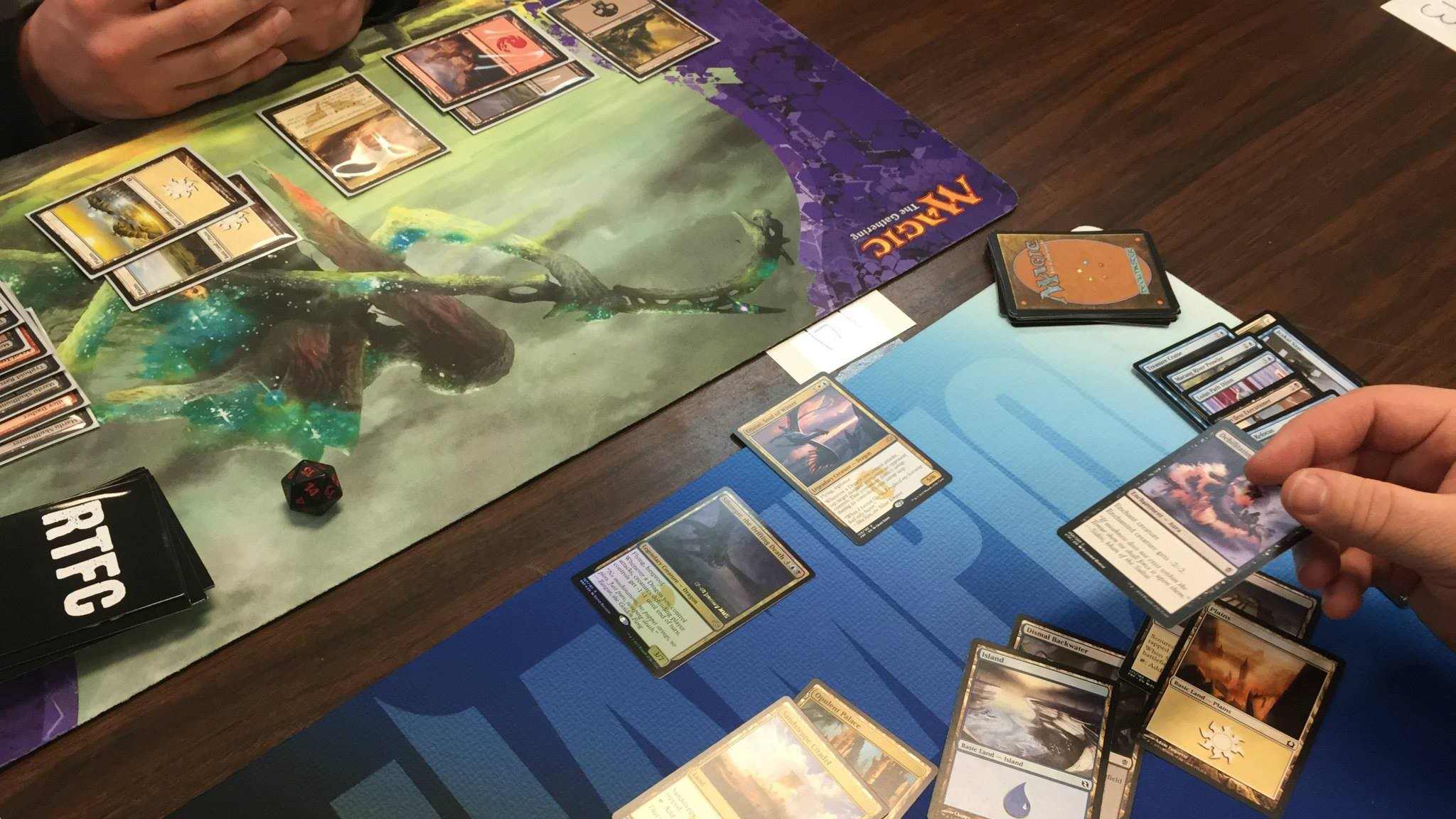
“The most overrated MTG Commander staples” sounds like an insult, but it really should not. Overrated does not mean bad. It means people talk about a card like it belongs in everything when it actually belongs in some things. And in Commander, that mistake happens constantly because the format is huge, social, and deeply vulnerable to received wisdom.
That matters even more now that Wizards says Commander bracket adoption continues to grow and more players are using brackets in pregame conversations. In the February 2026 update, Wizards said they were seeing more people label decks as Bracket 2 Core, which is useful context here. The more people talk honestly about what their decks are trying to do, the less sense it makes to treat every “staple” like a moral obligation.
So this is not a list of bad cards. It is a list of cards that get auto-included too often, defended too aggressively, and treated like universal truths when they are really context cards.
Temple of the False God
Let’s start with the old villain.
Temple of the False God is not unplayable. It is just one of the most common “my deck is slower than it should be and I would like to blame fate” cards in Commander. When it works, it feels free. When it does not, it sits in your opener impersonating a land while doing absolutely nothing.
That is the problem. Commander decks already need reliable early mana. Culture of Gaming’s basic Commander deckbuilding guide recommends starting around 36 to 39 lands, plus 8 to 12 ramp pieces for many decks. A card that is dead early and only catches up later is often solving the wrong problem. If your deck needs help getting to five lands, Temple is not help. Temple is a postcard from the future.
Reliquary Tower
This one survives almost entirely on vibes.
Yes, no maximum hand size is nice. No, most Commander decks do not actually need a dedicated land slot for it. A lot of players are using Reliquary Tower as emotional support for the fantasy that they will always have twelve cards in hand and all of them matter equally. In practice, if you are regularly discarding at cleanup, there are usually two possibilities. Either your deck is drawing a ton and already doing great, or it is drawing cards without turning them into action fast enough.
In other words, Tower often patches a symptom, not the structure. A better mana land usually helps more.
Commander’s Sphere
Commander’s Sphere is the Commander version of a perfectly decent office chair that people keep talking about like it is a throne.
Three-mana rocks have gotten worse as Commander decks have gotten tighter. If your deck is slow, casual, and just wants a little fixing, Sphere is fine. But as a default staple, it is overrated. Two-mana ramp usually matters more, because getting from two to four is much more important than getting from three to five one turn later. Even Culture of Gaming’s mana-base guidance makes the larger point clearly: cheap ramp matters more than expensive ramp because it actually fixes your early game instead of rewarding you for already having one.
Commander’s Sphere is still defensible in grindy shells, artifact decks, and lists that care about the sacrifice for a card. But as an auto-include? No. We can stop pretending.
Chromatic Lantern
Chromatic Lantern is good. It is also one of the easiest cards to overrate because it feels like it solves everything.
In four- and five-color decks, sure, it can still be exactly what you want. In three-color decks with a sane mana base, or in two-color decks where people just got nervous, Lantern is often doing less than its reputation suggests. If your mana base needs Lantern to function, the deck usually has a land problem, not a Lantern opportunity.
And because it costs three mana, you are paying a real tempo cost for that fixing. Sometimes that is worth it. A lot of the time, it is just a very polite way to admit your lands are arguing with each other.
Solemn Simulacrum
This one hurts a little because it is such a classic.
Solemn Simulacrum is still fine. That is the word for a lot of overrated staples, honestly: fine. But Commander players still talk about Sad Robot like it is frozen in amber from a time when value creatures had to walk uphill both ways to generate cardboard. Four mana for one basic land and one eventual card is no longer the kind of rate that automatically deserves a slot.
In blink decks, recursion decks, sacrifice decks, and artifact shells, absolutely. In “generic midrange pile that wanted something responsible at four mana,” much less so. Nostalgia is doing a lot of the lifting here.
Swiftfoot Boots and Lightning Greaves
I am grouping these together because they create the same deckbuilding mistake in slightly different clothes.
Protection for your commander is important. But not every commander wants equipment-based protection, and not every deck wants to spend early turns deploying boots instead of developing the board. If your commander is the whole engine, great. If your commander is just one strong card in a deck that can function without it, auto-including both of these can be overkill.
This is especially true when the deck already has other ways to protect its plan, or when the commander does not need to attack, tap, or survive at all costs. People remember the games where Greaves was perfect. They forget the games where it was just a piece of tableware.
Cultivate and Kodama’s Reach in every green deck
These cards are good. They are also not mandatory.
Commander players often treat Cultivate and Kodama’s Reach like green’s official uniform. But the question is not “are these playable?” It is “are these the best ramp spells for this deck?” In lower-curve decks, decks with lots of one- and two-mana setup, or decks that want to double-spell faster, three-mana ramp can be clunky. That does not make the cards bad. It makes them less universal than their reputation.
Again, cheap ramp is usually what actually changes how your deck feels. If your deck is trying to do something meaningful before turn four, Cultivate is sometimes just a respectable way to be late.
Thought Vessel
This is basically Reliquary Tower wearing a mana rock costume.
Two-mana rocks are good, so Thought Vessel starts from a better baseline than Tower does. But the “no maximum hand size” text still gets overvalued in a lot of decks. If you need a two-mana rock, there are plenty of them. Thought Vessel is nice when your deck genuinely expects to stockpile a huge hand. It is much less impressive when that extra line of text is just there to make the card feel more premium.
A lot of Commander staple evaluation goes wrong because people credit a card for all the games where it was solid and then quietly imagine its bonus text mattered more than it did.
The real problem with “staples”
The biggest issue is not any one card. It is the habit.
Culture of Gaming’s Commander guide puts it well in a different context: most functioning decks start with boring numbers and then get creative. That is good advice here too. A staple is not automatically correct because it is famous. It is correct when it supports your commander, your curve, your table, and your actual game plan.
And once you start thinking that way, commander staple discourse gets much healthier. You stop asking, “Should every deck run this?” and start asking, “What job is this doing here?” That is a much better question.
Final thoughts
The most overrated MTG Commander staples are usually not traps. They are just cards whose reputations escaped their context.
Temple of the False God is not evil. Reliquary Tower is not a crime. Commander’s Sphere is not embarrassing. Solemn Simulacrum did not suddenly become fake. But all of them get played like they are default inclusions, and that is where the problem starts.
Commander is too broad for universal answers. Which is inconvenient, sure, but also kind of the whole point.
References
- Wizards of the Coast, Commander Brackets Beta Update – February 9, 2026 for current bracket adoption context.
- Culture of Gaming, MTG Commander Explained: History, Rules, and How to Start for general Commander deckbuilding baselines.
- Culture of Gaming, How to Build a Mana Base That Doesn’t Hate You for the “cheap ramp matters more” framing.
SEO Title: The Most Overrated MTG Commander Staples
Meta Description: The most overrated MTG Commander staples are not always bad cards. They are just overplayed, over-defended, and often not universal.
Slug: most-overrated-mtg-commander-staples
How to Choose a Commander in MTG When You Have Too Many Options
How to choose a commander in MTG when you have too many options is a very normal problem now. It is not you. The card pool is enormous, Commander is still Magic’s most popular casual multiplayer format, and EDHREC noted that Wizards released 484 new commanders in 2025 alone, which is 161 more than in 2024. That is not a healthy amount of choice. That is a buffet trying to develop sentience.
And because Commander is a 100-card singleton format built around one face-up legendary creature, the choice matters more than people sometimes admit. Your commander does not just determine color identity. It shapes how the deck feels, how often you see your plan, and what kinds of games you tend to create. Wizards’ official Commander overview still frames the format around that central legendary card in the command zone, and that is the right place to start: your commander is not just a mascot. It is the deck’s operating system.
Start with what kind of game you actually want
This is the step people skip because they want to look at cool legends immediately.
Do not start with colors. Do not start with EDHREC rankings. Do not start with the card your friend said was “broken.” Start with the game experience you want. Do you want to attack? Grind value? Cast huge spells? Make tokens? Reanimate things? Play control without becoming the least popular person in the room? Those are better first questions than “which Esper commander is strongest.”
EDHREC’s guide to choosing your commander makes a similar point by focusing on things like archetype, colors, and favorite cards as real entry paths, not just raw power. That is the useful mindset. A commander is easier to choose when you know what kind of fun you are trying to buy.
Pick a commander that tells you what the deck wants
This is still the best beginner and intermediate rule.
Culture of Gaming’s Commander primer puts it very simply: good first commanders reward you for doing something normal, provide card advantage or mana over time, and do not require a five-card combo to matter. That is excellent advice because it solves the most common bad-commander problem, which is choosing something that only looks cool when everything is already perfect.
If your commander says something like “whenever you cast creatures, draw cards,” great. If it says “whenever you do the main thing this deck already wants to do, get paid,” also great. If it says “assemble a tiny legal brief out of layered replacement effects and then maybe I become a threat,” maybe save that for later.
A commander that tells you what the deck wants is not “less creative.” It is more honest.
Choose your colors based on your patience, not your ego
People love ambitious color identities because ambition feels like upside. Sometimes it is. Sometimes it is just more ways to lose to your mana.
Two-color commanders are easier to build, easier to cast, and usually easier to upgrade. Three-color commanders open more possibilities but ask more of your mana base and deck construction. Four- and five-color commanders are fun when you know what you are doing, but they can also become a pile of expensive fixing, muddled identity, and cards you swear “all technically work together.”
If you already know you get overwhelmed by deckbuilding, fewer colors is usually the smarter start. That is not a moral judgment. It is just triage.
Do not confuse “most powerful” with “best for you”
This is where a lot of Commander indecision gets weird.
A powerful commander is not automatically the right one. EDHREC’s commander-choice article talks about picking for archetype, colors, or cool cards you want to use, and that is healthier than choosing the legend with the most fear-inducing reputation online.
Some commanders are strong because they are efficient engines. Some are strong because they are linear and hard to disrupt. Some are strong because they make everyone at the table look at you like you just parked illegally at a wedding. None of that automatically means they are a good fit.
The right commander is the one you will enjoy playing more than once. Ideally more than twice. Preferably without having to apologize for the experience every game.
Look at your favorite cards, then work backward
This is one of the most useful shortcuts.
If you already know you love sacrifice effects, blink cards, giant Dragons, token swarms, graveyard loops, or combat triggers, use that. Commander is one of the few formats where “I like these kinds of cards” is a genuinely strong deckbuilding foundation. EDHREC explicitly points to cool cards as one of the valid reasons to choose a commander, and that is good advice because it turns a giant open-ended question into something human-sized.
If three or four cards always make you happy when you draw them, ask which commander supports those cards best. That usually gets you to a better answer than scrolling legendary creatures until your brain liquefies.
Build for your actual table
This part matters more than internet rankings.
Culture of Gaming’s Commander guide says it plainly: build for the table you actually play at. Ask whether your games end through combat, combo, or attrition. Ask whether people run lots of board wipes or fast mana. Ask whether “infinite combo” is acceptable or treated like a declaration of war. Those questions matter because the same commander can feel brilliant in one pod and miserable in another.
This also connects to the bracket conversation. Wizards said bracket adoption is growing, and more people are using those labels in pregame discussions. That makes commander choice even more context-sensitive. A commander that is perfect for a Bracket 2 Core table may feel boring or underpowered in a much stronger pod. A commander that is great in optimized games may feel oppressive in casual ones.
You are not choosing in a vacuum. You are choosing for a room.
Use a short filter when you are stuck
When you narrow it down to a few commanders and still cannot decide, use a simple filter:
Which one makes the most sense after the first board wipe?
Which one still functions if it gets removed twice?
Which one has the clearest card choices?
Which one sounds fun even when it loses?
That last question is underrated. Commander is multiplayer. Games can run long. Wizards still lists typical Commander game length at 120 minutes. If your commander only feels fun when it snowballs, you are going to have a lot of evenings where your deck feels like a sulk in sleeves.
A very practical way to choose your next commander
If you want the short version, here it is.
Pick a playstyle first. Then pick the fewest colors needed to support it. Then choose a commander that rewards you for doing the normal thing that playstyle already wants. Then check whether it fits your real table.
That process is not glamorous, but it works. And it avoids the classic Commander trap where you choose a legend because it looked amazing in a vacuum and then spend three weeks building a deck that feels like a compromise between six different impulses and one bad mana base.
Final thoughts
How to choose a commander in MTG when you have too many options comes down to choosing the experience, not the hype.
Pick the kind of games you want. Pick colors you can actually support. Pick a commander that tells you what the deck wants. And pick something that still sounds fun when the game gets messy, because Commander games always get messy.
You do not need the strongest legend. You need the one that makes you want to shuffle up again.